If you're running a commercial training company and you've outgrown spreadsheets, you've probably encountered this question: Do I need a Training Management System (TMS) like Arlo or accessplanit, or should I invest in a proper CRM like Dynamics 365 or Salesforce?
It's presented as an either/or choice. Fast and limited, or powerful and slow. But having implemented D365 for training companies ranging from startups to £10m+ operations, I've found there's a third path that most people don't consider.
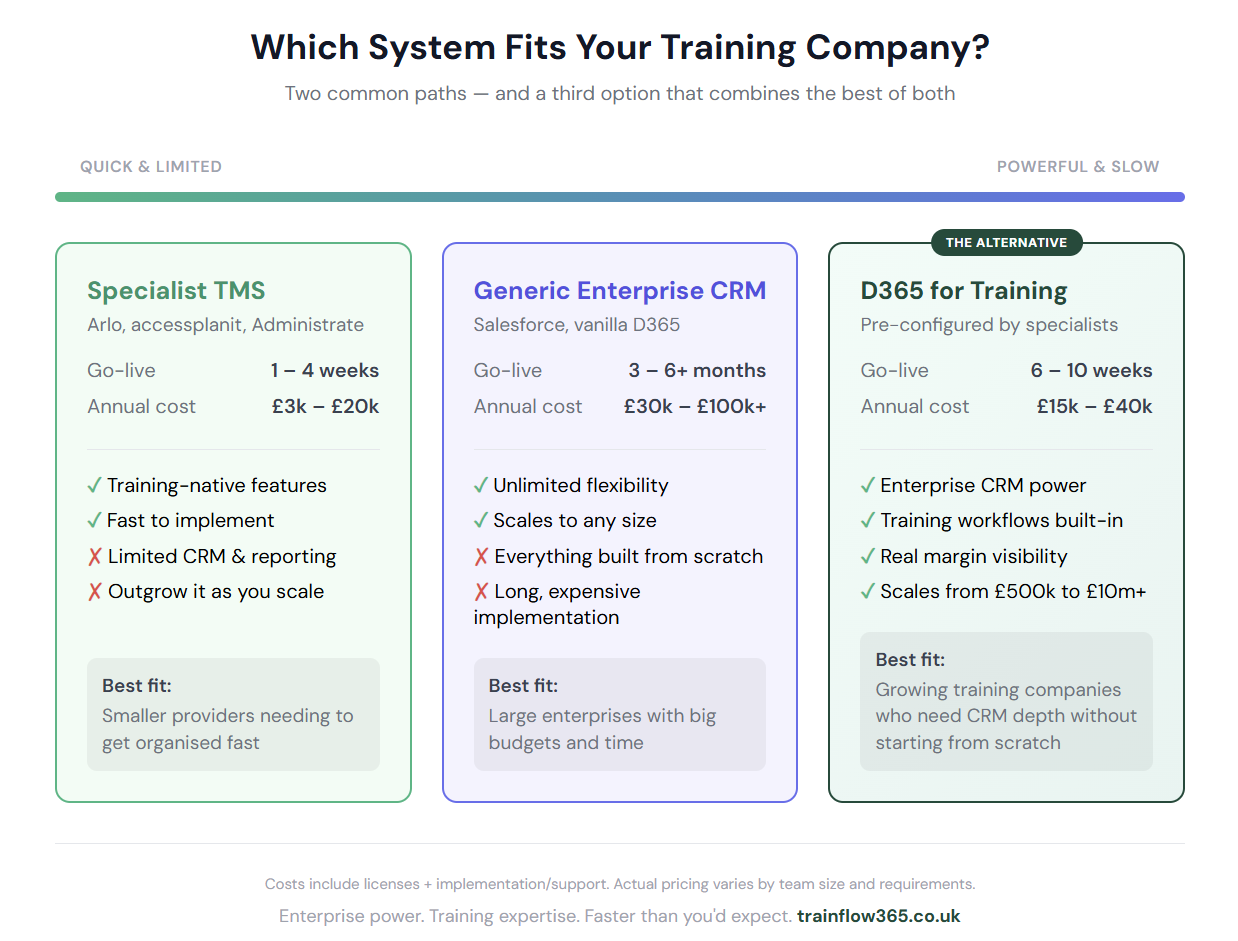
The Two Paths Everyone Knows About
Path 1: Specialist TMS (Arlo, accessplanit, Administrate)
These platforms are purpose-built for training companies. They understand courses, delegates, venues, and trainers out of the box. You can be operational within weeks.
The appeal: Fast setup, training-native features, reasonable cost (£3k–£20k/year depending on size).
The problem: Limited CRM functionality. When you start winning larger corporate contracts, need sophisticated sales pipeline management, or want proper margin visibility across your business, you hit walls. The systems are designed for training administration, not business growth.
I've spoken with training company owners doing £2m+ revenue who've outgrown their TMS but feel trapped—migration looks painful, and they're not sure what to migrate to.
Path 2: Generic Enterprise CRM (Salesforce, vanilla D365)
These platforms can do almost anything. Unlimited flexibility, enterprise-grade reporting, scales to any size.
The appeal: No ceiling. Whatever you need, it can be built.
The problem: They know nothing about training. You'll spend 3–6+ months and £30k–£100k+ configuring custom objects for courses, delegates, margins, and trainer assignments. And even then, the system only works as well as the consultants who built it—most of whom have never actually run training operations.
The uncomfortable truth: I've seen training companies spend £50k+ on Salesforce implementations that their teams barely use—because the system was built by CRM experts who didn't understand how training businesses actually operate.
The Third Path: D365 Configured for Training
Here's what most people miss: you don't have to choose between "fast but limited" and "powerful but painful."
If someone has already built D365 for a training company—with the custom entities, workflows, margin tracking, and integrations already figured out—you get the enterprise power without the 6-month implementation.
This is the approach I take. Having implemented D365 for training operations at companies doing £10m+ revenue, I've already solved the hard problems: how to structure course and delegate data, how to track margins in real-time, how to integrate with Xero/QuickBooks, how to automate the communications that ops teams waste hours on.
For a new client, that means:
- 6–10 weeks to go-live, not 6 months
- Enterprise CRM depth—proper sales pipelines, account management, forecasting
- Training workflows already built—courses, delegates, venues, trainers, margins
- Scales with you—works for £500k revenue, still works at £10m+
- Microsoft 365 native—Outlook, Teams, SharePoint integration that actually works
A Practical Comparison
| Factor | Specialist TMS | Generic Enterprise CRM | D365 for Training |
|---|---|---|---|
| Time to go-live | 1–4 weeks | 3–6+ months | 6–10 weeks |
| Training-specific features | Excellent out of box | Must be built from scratch | Pre-configured |
| CRM/Sales depth | Basic | Excellent | Excellent |
| Margin visibility | Limited | If built correctly | Built-in |
| Annual cost (licenses + support) | £3k–£20k | £30k–£100k+ | £15k–£40k |
| Scales to | ~£2m revenue | Unlimited | £10m+ proven |
| Microsoft 365 integration | Via connectors | Varies | Native |
The Questions That Actually Matter
Before you evaluate any system, answer these honestly:
1. What's your sales cycle like?
If most bookings come through your website with minimal sales involvement, a TMS might be enough. But if you're quoting for corporate contracts, managing relationships across multiple stakeholders, and nurturing leads over months—you need proper CRM functionality that most TMS platforms simply don't have.
2. Do you actually know which courses are profitable?
Revenue tracking is easy. Real margin visibility—tracking trainer costs, venue hire, materials, and travel against individual course instances in real-time—is where most systems fall down.
If you're making decisions based on gut feel rather than data, that's a system problem, not a discipline problem.
3. What breaks when you double in size?
This is the question that separates good decisions from expensive ones. If you double your course volume next year, what manual processes become unsustainable? If you hire three more salespeople, will they be fighting over the same spreadsheet?
A TMS that works at £500k revenue might be painful at £1.5m. But investing £80k in a full enterprise build when you're at £800k revenue is equally wrong.
4. How important is the Microsoft ecosystem?
If your team lives in Outlook, Teams, and SharePoint, native D365 integration is genuinely valuable—calendar sync that works both ways, documents in the right place, Teams notifications that don't require Zapier workarounds.
If you're a Google Workspace shop, this matters less.
When Each Approach Makes Sense
Choose a specialist TMS if:
- You're under £500k revenue and need to get organised quickly
- Most of your business is open courses with simple booking flows
- You don't have complex B2B sales cycles
- You're comfortable migrating to something else in 2–3 years if you grow significantly
Choose D365 configured for training if:
- You're between £500k and £10m+ revenue (or heading there)
- You have a mix of open courses and corporate/B2B work
- You need real CRM functionality—pipeline management, account relationships, forecasting
- Margin visibility matters to your business decisions
- You want a system that scales with you rather than one you'll outgrow
Choose a full enterprise CRM build if:
- You're a large organisation with very specific requirements
- Training is part of a broader service portfolio that needs unified systems
- You have the budget (£50k+) and timeline (6+ months) for a proper implementation
- You have internal technical resources to maintain it long-term
Questions to Ask Any Vendor
Regardless of which direction you go:
- Can I talk to a training company at my size using this? Not a case study—an actual conversation.
- How do you handle course-level margin tracking? If they can't answer this clearly, they don't understand training businesses.
- What's the realistic implementation timeline? Then add 50% for reality.
- What happens when I outgrow the current setup? Get specific on pricing at 2x and 3x your volume.
- Who supports me after go-live? A ticket system isn't the same as someone who knows your setup.
The Bottom Line
The choice isn't really TMS vs CRM. It's about finding a system that fits where you are now while giving you room to grow.
For most growing training companies—the ones doing £500k to £10m+, with a mix of open and corporate business, who need proper margin visibility and sales functionality—the "fast but limited" and "powerful but painful" options both miss the mark.
There's a middle path: enterprise-grade D365, pre-configured for training operations, implemented by someone who's actually done it before. That's what we do.